












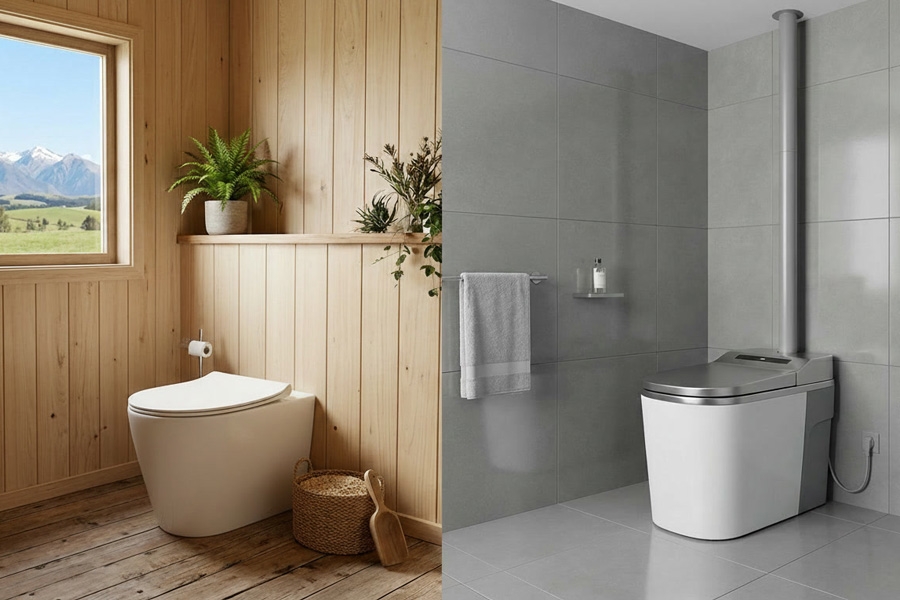
Composting toilets and incinerating toilets are both waterless, but that is where the similarity largely ends. One manages human waste through a biological process. The other uses repeated high-temperature treatment to reduce waste to ash.
That difference affects almost everything that matters in a real New Zealand project: energy demand, reliability, running cost, outage resilience, servicing, system capacity and how well the technology can scale beyond a single household toilet.
Incinerating toilets have attracted attention because the idea is easy to understand: use the toilet, burn the waste, remove a small amount of ash. But simplicity of explanation should not be confused with simplicity of operation.
For WCTNZ®, the more important question is whether a toilet technology remains practical when the site is remote, the power supply is limited, the number of users increases, or the system is expected to remain in service for many years.
The short answer
For many off-grid, rural, residential and infrastructure-limited New Zealand projects, composting toilets have the stronger long-term engineering case. Their primary treatment process is biological, their treatment energy demand can be very low, and the technology can be scaled from a single household system through to multi-pedestal commercial and public sanitation installations.
Incinerating toilets can suit particular applications, but they remain dependent on repeated high-temperature treatment cycles, a dependable source of electricity or fuel, and the throughput limits of the individual appliance.
Biological treatment versus thermal treatment
A composting toilet is fundamentally a biological treatment system. Human waste, toilet paper and carbon material are retained within a managed environment where airflow, moisture balance, retention time and biological activity progressively reduce and stabilise the material.
An incinerating toilet takes the opposite approach. Instead of retaining material for biological decomposition, it uses heat to drive off moisture and thermally reduce the waste to a small ash residue.
The important distinction is not simply that both technologies avoid flush water. A composting toilet can perform its primary treatment through managed biological processes; an incinerating toilet cannot complete its treatment without repeated high-temperature energy input.
That becomes particularly important when the toilet is being considered for a site precisely because conventional infrastructure is limited.
Composting and incinerating toilets compared
| Consideration | Composting toilet | Incinerating toilet |
|---|---|---|
| Primary process | Managed biological decomposition and stabilisation | High-temperature thermal reduction |
| Flush water | No flush water required | No flush water required |
| Treatment energy | Can be very low; some systems use only ventilation while others use additional heat or mechanical assistance | Requires substantial heat energy during treatment cycles |
| Power interruption | Most systems retain usable toilet capacity during a temporary outage, although powered ventilation, heaters or pumps should be restored as required | Thermal treatment cannot be completed without the required electricity or fuel |
| Running cost | Generally low, especially with passive or low-energy systems | Energy or fuel is an ongoing operating cost |
| Mechanical dependency | Can be relatively simple, particularly passive and low-energy designs | Relies on high-temperature components, controls, fans and treatment-cycle equipment |
| Capacity | Can be increased through larger chambers, multiple chambers, chamber rotation, parallel systems and multiple pedestals | Bound by the collection volume, burn cycle, energy availability and duty capability of the appliance |
| Commercial scale | Established architecture for central systems serving multiple toilet pedestals and larger facilities | No established commercial-scale incinerating toilet pathway in New Zealand; available systems are primarily appliance-scale |
| Residual material | Composted or partly composted organic material requiring the relevant system-specific maturation or handling pathway | Small quantity of ash |
The ash output is an obvious strength of incineration. What the simple comparison often misses is the infrastructure required to create that ash every time the toilet is used.
Waterless does not automatically mean off-grid friendly
It is easy to place all waterless toilets into the same “off-grid” category. Technically, however, the energy requirements can be completely different.
A composting toilet may require nothing more than ventilation. Some systems use a small continuous fan, while more automated models can use heaters, mixers or other powered components. Even then, the underlying treatment mechanism remains biological.
An incinerating toilet must repeatedly generate enough heat to evaporate liquids and thermally process the waste. That energy demand is fundamental to the technology rather than an optional accessory.
On a grid-connected property with plentiful electrical capacity, that may be acceptable. On a solar, battery or generator-dependent property, the same demand becomes part of the site's energy infrastructure.
This is why WCTNZ® does not regard “waterless” and “off-grid” as interchangeable terms. Removing flush water solves one infrastructure dependency. Replacing it with a substantial energy dependency can simply move the problem elsewhere.
What happens when something stops working?
Reliability is one of the areas where the technologies differ most strongly.
Composting systems can range from extremely simple passive installations to more automated appliances. In the simpler systems there are comparatively few critical components. Even where a ventilation fan is used, the treatment chamber itself still exists as substantial physical storage and biological processing capacity.
If electrical power disappears temporarily, most composting toilet systems do not suddenly become unusable toilets. Normal powered operation should of course be restored, particularly where ventilation or heating is part of the specified design, but the user has not lost the underlying treatment volume.
An incinerating appliance is different. If the burner, heating system, control system, fan, electricity supply or fuel supply is unavailable, the process that makes the system function cannot be completed.
For a remote property, resilience is not only about whether a toilet works on its best day. It is about what remains available when the power is out, a component fails, a replacement part is delayed or the site is difficult to service.
A composting system can become infrastructure
One of the biggest differences between the technologies appears when a project moves beyond a single household toilet.
A self-contained incinerating toilet is fundamentally a processing appliance. Its throughput is constrained by its collection arrangement, processing cycle, energy availability and appliance duty limits.
A composting system does not have to remain a single appliance.
Household and compact scale
Self-contained and smaller split systems can service individual homes, baches, cabins, tiny houses and other lower-scale applications.
Multi-user and accommodation scale
Larger chambers, batch arrangements and multiple systems can support higher occupancy, accommodation, campground and shared-use applications where the installation is properly sized and managed.
Commercial and public scale
Central composting systems can connect multiple toilet pedestals to substantial treatment volume and become part of the sanitation infrastructure of a building or facility rather than simply multiplying individual toilet appliances.
A commercial composting installation is therefore not simply a larger version of a household toilet.
Large treatment chambers can provide long retention periods. Multiple chambers can provide rotation or redundancy. Several toilet pedestals can feed a central chamber. Parallel systems can expand capacity as the facility grows.
This is why composting technology is found not only in homes and cabins, but in campgrounds, public toilet facilities, recreational sites, backcountry facilities and other installations where conventional sewer infrastructure is difficult or undesirable.
Scale is an architectural advantage. For a larger project, the question should not automatically be “How many domestic appliances do we need?” It can instead be “What sanitation system should this facility be designed around?”
WCTNZ® supplies commercial composting pathways including commercial toilet solutions and larger Clivus Multrum™ systems.
Why composting remains such a strong off-grid technology
Treatment with less dependency
Composting works by providing the conditions for natural biological decomposition rather than repeatedly applying large amounts of energy to destroy the material.
That offers a powerful combination for off-grid projects: no flush water, low treatment energy, substantial storage volume and the ability to scale the system around the actual project.
Treatment through energy
Incineration produces a very small residual volume and avoids managing composted material.
The trade-off is that every unit of waste must ultimately pass through an energy-intensive thermal process. The toilet therefore remains dependent on the appliance, its energy source and its cycle capacity.
For WCTNZ®, that trade-off matters.
If a project is trying to reduce its dependency on central infrastructure, delivered fuel, large electrical systems or complex servicing pathways, a biological sanitation technology can be a better match for the original goal.
The purchase price is only part of the comparison
Incinerating toilets can look attractive when the comparison is reduced to the cost of buying one toilet appliance.
The more useful comparison is whole-of-life cost.
That means considering the energy or fuel consumed over years of use, consumables, servicing, replacement parts, component life and the infrastructure required to support the toilet.
Composting toilets also require ongoing care. Depending on the system this may include bulking material, cleaning products, periodic chamber rotation or compost removal, fan replacement and routine inspection.
The difference is that the biological treatment itself does not need a new high-temperature energy cycle every time waste enters the system.
For a more detailed discussion, see The Real Running Costs of Off-Grid Toilets.
Neither technology is maintenance-free
Any claim that a specialist toilet requires no maintenance should be treated cautiously.
A composting toilet needs its biological process respected. That can include maintaining ventilation, adding the correct carbon material, monitoring moisture, periodically moving or removing composted material and keeping service components operational.
An incinerating toilet trades compost management for a different maintenance pathway: ash removal, cleaning, exhaust inspection, consumables where applicable, electrical or fuel-system components and servicing of equipment exposed to repeated high-temperature operation.
The more useful question is not which toilet has “no maintenance”. Neither does.
The question is what type of maintenance and long-term dependency the owner wants to carry.
A waterless toilet does not solve the whole wastewater site
Whether the toilet composts or incinerates, showers, hand basins, kitchens and laundries still produce wastewater.
This is particularly important on off-grid and rural properties, because removing the flushing toilet can dramatically reduce the blackwater burden without making the rest of the property's wastewater disappear.
WCTNZ® sees composting toilets and properly planned greywater systems as a particularly logical pairing because the waste streams can be addressed separately rather than first being mixed together with large quantities of potable flushing water.
Read more in Greywater and Composting Toilets: Why One Does Not Replace the Other.
So which technology would WCTNZ® choose?
WCTNZ® is a composting toilet specialist, and there is a reason we continue to see biological waterless sanitation as such a strong technology.
It can remove flush water without replacing that water dependency with a large treatment-energy dependency.
It can retain toilet capacity during temporary power interruptions in ways an active thermal treatment appliance cannot.
It can be built around comparatively simple components.
Most importantly, it can scale.
A technology that begins with a toilet in a small off-grid dwelling can also be designed around multiple pedestals and large central chambers serving public and commercial facilities.
For many genuinely off-grid, remote and infrastructure-constrained New Zealand sites, composting should be one of the first sanitation technologies assessed — not treated as the cheap alternative to a more technologically advanced incinerating toilet.
Incineration is technologically impressive, but more technology is not automatically better infrastructure.
Where the project objective is low energy demand, reduced infrastructure dependency, long-term resilience and scalable capacity, composting has a very strong case.
Composting vs incinerating toilet FAQs
Which is better: a composting toilet or an incinerating toilet?
For many off-grid, remote and infrastructure-limited sites, WCTNZ® considers composting the stronger long-term technology because it combines waterless operation with low treatment energy, substantial treatment capacity and the ability to scale. Incinerating toilets can suit particular applications where dependable energy and appliance-scale throughput are acceptable.
Are composting toilets more reliable than incinerating toilets?
Simple composting systems can have fewer critical high-temperature and electromechanical components than incinerating toilets. Reliability still depends on the specific product, installation and maintenance, but biological treatment can provide a comparatively resilient technology pathway.
Can a composting toilet still be used during a power cut?
Most composting toilets retain usable toilet capacity during a temporary electrical outage because the treatment chamber remains available. Powered fans, heaters, mixers or pumps should be restored in accordance with the system requirements. An incinerating toilet cannot complete its thermal treatment cycle without its required electricity or fuel.
Are incinerating toilets good for off-grid properties?
They can operate off-grid where the site has sufficient electricity or fuel, but being waterless does not automatically make them low-energy. Their treatment process depends on repeated heat cycles, so the energy supply must form part of the off-grid system design.
Which type has lower running costs?
Composting toilets will often have the lower energy running cost because biological treatment does not require repeated high-temperature cycles. Actual cost still depends on the individual system, its powered components, consumables, maintenance and level of use.
Can composting toilets be used commercially?
Yes. Commercial composting systems can use large central treatment chambers, multiple toilet pedestals, long retention periods, chamber rotation and parallel capacity. They can therefore form part of the sanitation infrastructure of larger public and commercial facilities.
Are commercial incinerating toilets available in New Zealand?
No. Incinerating toilets in the New Zealand market are primarily appliance-scale rather than an established commercial waterless-toilet pathway.
Planning a waterless toilet project?
WCTNZ® specialises in composting toilet systems from compact household applications through to larger commercial and public facilities. If you are working on an off-grid, rural, residential or infrastructure-limited project, talk to us about the composting pathway before assuming a higher-energy toilet technology is the better option.