
















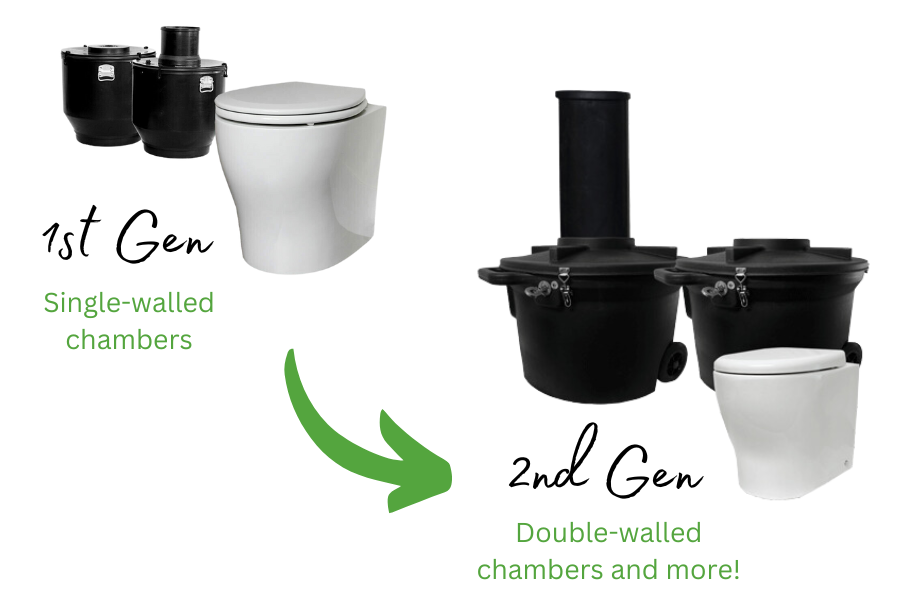
Split batching composting toilet systems improved significantly as manufacturers learned how chamber strength, airflow, moisture movement and physical handling affect real-world performance.
The move from early single-wall chambers to more developed double-wall designs was not merely cosmetic. It changed how the chamber held its shape, retained warmth, moved air and liquids, and could be handled during routine rotation.
This article records that design step—and explains why it helped set the foundation for the current generation of low-profile batching systems.
The short answer
Second-generation batching systems improved the chamber as both a treatment environment and a serviceable building product.
Double-wall construction, broader aeration, better handles, wheels and optional mixing made the systems sturdier, easier to move and more effective at using their available volume.
A composting chamber has to do more than hold material
A batching chamber receives solids, liquids, toilet paper and carbon-rich bulking material. It must retain its shape, support airflow, manage excess liquid and remain practical to disconnect and move when its active period ends.
Early systems demonstrated that batch rotation was a strong sanitation architecture, but they also exposed opportunities for better structure and serviceability.
Design evolution matters because the chamber is not simply a container. It is part of the composting environment and part of the owner's long-term maintenance pathway.
More structure and a more controlled chamber environment
One of the most visible second-generation improvements was the move to double-wall chambers. The outer wall provides structural support while the perforated inner section creates a separate pathway for airflow and liquid movement.
A more rigid chamber is easier to handle without distortion. The air gap between walls can also improve thermal buffering compared with a thin single-wall shell.
That does not make the chamber immune to freezing or remove the need for climate-appropriate sizing. It does provide a more robust platform for cold-weather management and for later developments such as insulation or model-specific heating.
Air can reach more than the top of the composting mass
Earlier chambers commonly relied on a perforated false floor and top-down ventilation. The developed double-wall arrangement added perforations around the lower sides as well as the base.
With a correctly operating fan, air can move around more of the chamber. The design also provides a pathway for liquid to pass through the inner wall rather than accumulating directly beneath the composting mass.
Better airflow supports aerobic conditions and moisture management. Actual performance still depends on the fan, vent route, bulking structure, loading and condition of the drainage pathway.
Chamber rotation became easier to manage
Batching systems work by moving a full chamber out of active service and replacing it with another. That makes chamber handling an important part of the design.
Detachable wheels allowed chambers to be rolled or tilted across a suitable surface instead of relying entirely on lifting. They also made it easier to move a resting chamber to its designated location and later position it for final servicing.
Site design still matters: wheels need a firm, reasonably level route. Gravel, steps, soft ground and insufficient clearance can defeat the benefit of a good chamber-handling system.
Strong moulded grip points reduce weak attachments
Moulding handles into the chamber body removed reliance on light external hardware attached to a flexible wall. A broad integrated grip is more comfortable and transfers handling loads through the chamber structure.
This is a small design feature with a large effect during real maintenance. The owner should still use safe lifting techniques and any trolley supplied for the system.
Use more of the chamber volume
Premium batching systems introduced internal mixing mechanisms. Mixing can redistribute material, break down the cone that forms beneath a central chute and move carbon material and biological activity through more of the mass.
The practical benefit is better use of chamber volume and more even conditions. The mechanism should be operated according to the model instructions; forcing a mixer through compacted or foreign material can damage components.
Clivus Multrum™ batching systems have used mixing as a point of difference, while later Nature Loo™ designs developed their own chamber features around low-profile residential use.
Heating can support the process where the model is designed for it
Some high-profile systems offered optional chamber heating for colder installations. Heat can support biological activity and moisture management, but it is not a substitute for correct capacity, ventilation and operation.
A project considering heating should include the actual electrical demand, controls, chamber insulation and expected winter loading in the system design.
Manufacturer walk-through: first and second generation
The following manufacturer video records the key differences discussed in the original article.
How the second generation led into Alectura
The principles developed in these systems—strong dual-wall chambers, air and liquid pathways, chamber mobility and better service access—continued into later designs.
The current Nature Loo™ Alectura Comfort and Alectura Premium add removable internal chamber components, moisture-managing base wicks, secure locking and inspection access. The Premium adds dual mixer blades and an Ezylift trolley.
That progression shows how product development can preserve a successful batching architecture while improving the details that matter to installers and owners.
Split batching design FAQs
Why use more than one composting chamber?
Multiple chambers allow one chamber to receive waste while another rests and continues treatment outside active service.
What is the benefit of a double-wall chamber?
It improves structural rigidity and creates a separate air and liquid pathway around the inner composting space.
Do mixer blades increase capacity?
They can improve usable chamber volume by redistributing the pile and supporting more even conditions. The result still depends on loading and correct operation.
Do wheels remove the need for access planning?
No. The chamber still needs sufficient clearance and a firm, practical route from the service area.
Are the old Classic and CM LP systems the current low-profile products?
They represent an earlier design generation. WCTNZ®'s current low-profile residential direction is the Nature Loo™ Alectura range.
Comparing batching systems for a new build?
WCTNZ® can help assess underfloor clearance, occupancy, climate, chamber access and whether the Comfort or Premium configuration better fits the project.