













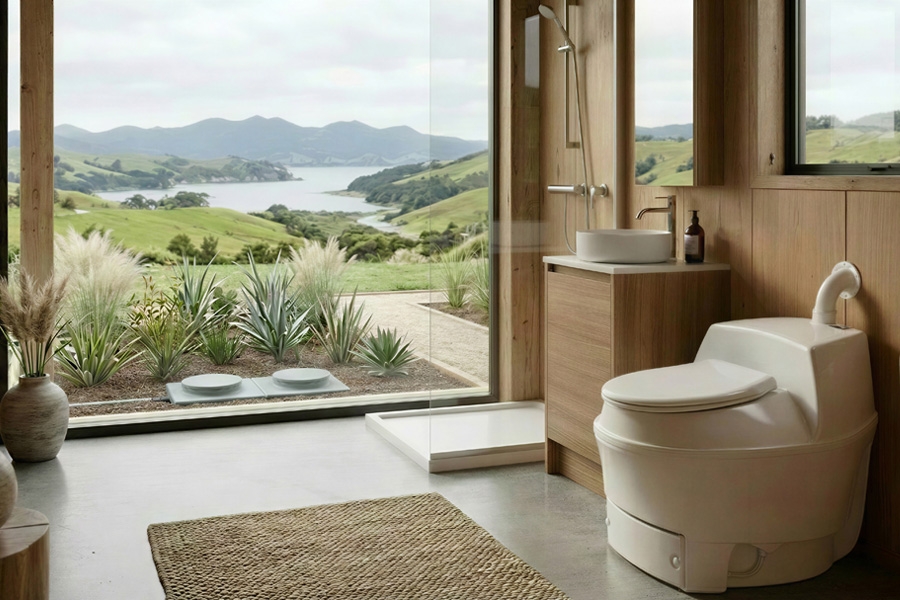
A composting toilet can solve the toilet-waste side of an off-grid wastewater project, but it does not make the rest of the household wastewater disappear.
Showers, hand basins, laundries, washing machines, kitchens and dishwashers still produce greywater. That water still needs a suitable discharge, reuse or treatment pathway.
This is one of the most common points of confusion in off-grid, tiny-home, bach and low-water wastewater planning. The toilet is often solved first because it feels like the main sanitation problem. Once the flushing toilet is removed, however, the greywater can become the largest wastewater stream left on the site.
That does not weaken the case for composting toilets. It is actually one of the reasons source-separated sanitation can be so useful: toilet waste and greywater can be managed as different wastewater problems rather than being mixed together from the beginning.
The short answer
A composting toilet and a greywater system do different jobs.
The composting toilet changes the toilet-waste or blackwater side of the project and removes the need to use large amounts of flush water to transport human waste. The greywater pathway manages wastewater from the rest of the building.
For many off-grid projects, the strongest overall design is therefore not a composting toilet instead of greywater management. It is a composting toilet plus an appropriate greywater pathway.
Why people think the composting toilet solves everything
The confusion is understandable.
For most households, the toilet is the fixture most strongly associated with sewage, septic tanks and wastewater disposal.
It therefore feels logical that removing the flushing toilet has removed the main wastewater problem.
That assumption is particularly common in tiny homes, cabins, baches and self-sufficient living projects where the toilet is often one of the first infrastructure decisions made.
But the building still uses water.
Removing the flushing toilet changes the wastewater profile of the property. It does not turn the rest of the building into a wastewater-free site.
What a composting toilet actually removes from the wastewater system
A conventional toilet mixes human waste with clean water and sends the combined stream into a sewer, septic tank or wastewater treatment system.
A waterless composting toilet changes that arrangement.
Human waste is managed through the composting system rather than being transported away in a conventional flush-water stream.
That can materially reduce potable-water demand and the volume of water-borne blackwater requiring downstream treatment.
For an off-grid or tank-water property, that is a substantial design advantage.
But it does not change what happens every time someone showers, washes clothes or uses the kitchen.
What wastewater is still produced?
| Source | Wastewater pathway | What the composting toilet changes |
|---|---|---|
| Toilet | Composting-toilet treatment pathway | Conventional flush-water blackwater is removed or substantially changed. |
| Showers and baths | Greywater | No change — this water still needs management. |
| Hand basins | Greywater | No change — the flow remains. |
| Laundry | Greywater | No change — washing-machine and laundry wastewater remains. |
| Kitchen and dishwasher | Greywater — generally a heavier greywater source | No change — kitchen wastewater still needs a suitable pathway. |
This is why greywater often becomes more visible once the toilet wastewater has been separated.
For the broader foundation, see About Greywater.
Why greywater often matters more after a composting toilet is installed
Once a conventional flush toilet is removed, the household wastewater profile changes significantly.
The toilet is no longer adding flushing water and human waste to the normal wastewater flow.
What remains may now be predominantly greywater.
That makes the greywater pathway one of the central design questions for the property rather than a minor afterthought.
Source separation changes the question. Instead of one mixed wastewater stream, the project can manage toilet waste and household greywater through different pathways suited to their different characteristics.
A composting toilet does not decide which greywater system you need
The toilet choice changes the wider wastewater context, but it does not automatically select the greywater technology.
The greywater response still depends on the actual wastewater source, use level, site and intended outcome.
A one-person cabin using mainly shower and basin water is a very different greywater project from a full-time household including kitchen and laundry wastewater.
Likewise, a site with good gravity fall and adequate land area may support different options from one requiring pumping or operating within a restricted discharge area.
See Greywater System Pathways for the wider decision structure.
The kitchen remains part of the greywater calculation
Kitchen wastewater does not become blackwater simply because a composting toilet has been installed.
WCTNZ® treats kitchen wastewater as greywater, while recognising that it is generally one of the heavier household greywater sources because of grease, oils, food solids and higher organic loading.
That means kitchen inclusion can materially change the greywater-system discussion without changing the basic wastewater category.
For the dedicated explanation, see Is Kitchen Wastewater Greywater? Clearing Up a Common Misunderstanding.
Composting toilets and greywater systems can complement each other
The two technologies are not competing for the same job.
The composting toilet deals with the toilet-waste stream without conventional flushing.
The greywater system addresses wastewater from the rest of the household.
Together, they can create a source-separated wastewater architecture that avoids unnecessarily mixing toilet waste with large volumes of relatively lower-strength household water.
A composting toilet and greywater system are often strongest when they are treated as two coordinated parts of one wastewater strategy rather than two unrelated product decisions.
What still needs to be understood
- Which fixtures will enter the greywater stream?
- Is kitchen wastewater included?
- How many people will use the property and how often?
- Is gravity fall available or will pumping be required?
- What discharge or irrigation area is available?
- Is the project seeking simple diversion or a more controlled treatment and reuse pathway?
Those questions usually reveal much more about the likely system than the composting-toilet model alone.
See Greywater Diversion vs Treatment: What Changes the Decision?.
One system handles the toilet. The other handles the water that remains.
A composting toilet can make a major difference to an off-grid or low-water wastewater project.
It reduces flush-water demand and changes the blackwater pathway.
But it does not remove the showers, laundry, hand basins, kitchen or dishwasher.
The remaining greywater still needs to be managed as a genuine wastewater stream.
The best source-separated projects understand both sides from the beginning: the composting toilet manages toilet waste, while the greywater pathway manages the rest of the building's wastewater.
Composting toilet and greywater FAQs
Do I still need a greywater system if I have a composting toilet?
Yes. A composting toilet changes the toilet-waste pathway, but showers, basins, laundry, kitchens and other non-toilet fixtures still produce greywater that needs a suitable pathway.
What wastewater does a composting toilet remove?
It removes or substantially changes the conventional water-borne toilet-waste stream by treating human waste without normal flush water.
Is kitchen wastewater still greywater?
Yes. WCTNZ® treats kitchen wastewater as greywater. It is generally a heavier and more demanding greywater source because it can contain grease, oils, food solids and higher organic loading.
Do composting toilets and greywater systems work well together?
They can. They manage different wastewater streams and can form a logical source-separated sanitation strategy when each system is matched correctly to the project.
Does greywater always need treatment after installing a composting toilet?
No. Whether diversion or treatment is appropriate depends on the greywater sources, level of use, site conditions and intended discharge or reuse outcome.
Planning a composting toilet and greywater system together?
WCTNZ® can help work through the toilet pathway, remaining greywater sources, occupancy, site conditions and likely greywater system direction as one project.