















For some off-grid properties, “no LPG, no flame” is not a marketing slogan. It is a deliberate infrastructure choice.
The owner may want waterless sanitation without storing fuel, depending on combustion equipment or using high-temperature treatment cycles every time toilet waste needs to be processed.
That can matter at solar-powered baches, remote cabins, rural buildings, huts, workshops and other sites where water, power and access are already constrained.
Where reducing those dependencies is part of the project goal, a correctly selected composting toilet should be one of the first technologies considered.
The short answer
A composting toilet can provide waterless sanitation without requiring LPG, flame or high-temperature waste treatment as its primary process.
Not every incinerating toilet uses LPG — some are electric — and different systems have different operating requirements. The important point is that composting uses biological treatment rather than combustion, creating a strong pathway for sites trying to minimise both water use and energy or fuel dependency.
“No LPG, no flame” is a design preference
The phrase does not mean every alternative toilet is unsafe.
It does not mean every incinerating toilet uses LPG.
It does not mean every powered toilet works the same way.
It means the project owner wants a sanitation pathway that does not rely on stored fuel, combustion or repeated high-temperature waste reduction as part of normal operation.
For a genuinely off-grid project, reducing operating dependencies can be just as important as removing flush water.
When does a no-fuel toilet pathway become attractive?
| Site question | Why it matters |
|---|---|
| Is electrical power limited? | High treatment loads compete with refrigeration, pumps, lighting, communications and other essential site services. |
| Is fuel storage undesirable? | LPG or other fuel adds storage, transport, refilling and handling requirements. |
| Is the site difficult to access? | Fuel supply, service visits and appliance repairs become more consequential as access becomes harder. |
| Is long-term simplicity important? | Reducing specialised operating dependencies can make the sanitation system easier to own over time. |
| Is the site intended to remain genuinely off-grid? | A toilet with a substantial permanent energy demand can work against the wider low-dependency design strategy. |
A composting toilet works through biology rather than combustion
A composting toilet does not reduce human waste by burning it.
It retains waste within a system designed to support biological decomposition through airflow, carbon structure, moisture balance and time.
Depending on the design, the toilet may be passive, naturally ventilated, low-voltage fan-assisted or more mechanically supported.
That flexibility matters because the energy architecture can be matched to the project rather than making high-temperature processing a fixed requirement.
Low energy does not mean no design. A composting toilet still needs sufficient capacity, suitable ventilation, correct moisture balance and a realistic servicing pathway.
Stored electricity is a limited resource
On a normal grid-connected property, appliance demand is largely hidden behind the power socket.
On a solar-powered site, every load has to be generated, stored and delivered.
That means toilet energy can compete with refrigeration, water pumping, lighting, communications, space heating and other services.
If the project goal is independence, it makes sense to ask whether limited stored energy should routinely be used to thermally destroy a wet waste stream.
Our deeper comparison Composting vs Incinerating Toilets in NZ: Power, Reliability & Scale examines this in more detail.
Fuel supply is only one part of the dependency
Adding LPG or another fuel source does more than create a running cost.
The fuel needs to be stored safely, monitored, replaced and transported to the site.
At a road-accessible property that may be straightforward. At a remote hut, isolated property or public facility, the logistical cost can matter more.
The same principle applies to specialised appliance servicing. A component failure that is easily addressed in town can be much more disruptive in a remote location.
One of composting technology's strongest off-grid advantages is that treatment capacity can be created through chamber volume and biological time rather than through repeated fuel or high-energy processing cycles.
Sites where composting deserves an early look
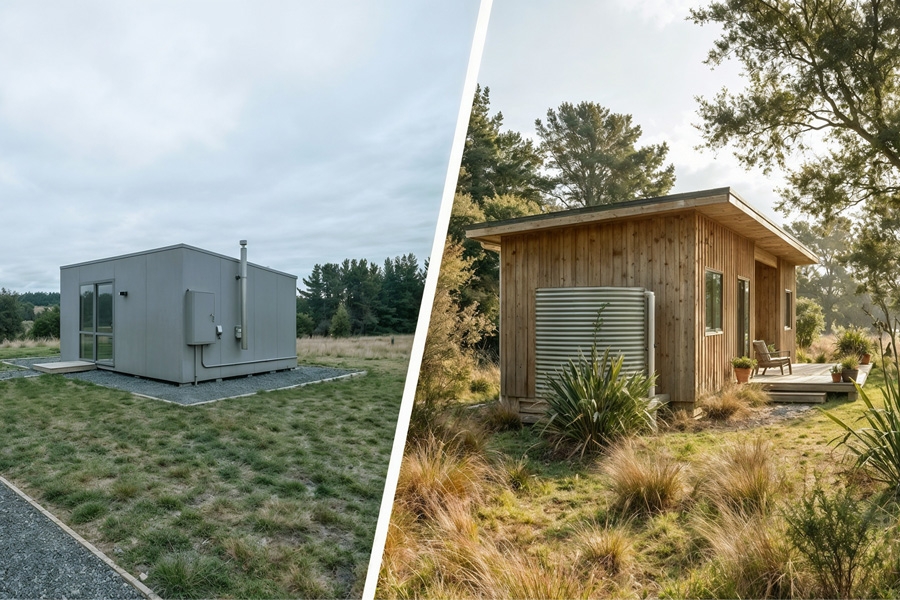
A no-fuel or low-energy composting pathway can be particularly relevant for solar-powered baches, low-power homes, cabins, huts, tiny homes, workshops, rural properties and some remote public facilities.
The common feature is not the building type.
It is the desire to keep infrastructure demand low.
Where water is scarce, energy is limited and servicing access is difficult, removing another operating dependency can materially improve the overall system.
Composting still has to be sized properly
A composting toilet is not a magic box and low energy should never be used as an excuse to undersize the system.
The toilet still needs enough treatment capacity for the expected loading, suitable ventilation, moisture management, appropriate carbon material and a workable maintenance routine.
A compact toilet intended for occasional use is not automatically the right answer for a full-time off-grid home just because it uses little electricity.
See the WCTNZ® Capacity & Usage Definitions and Composting Toilet Guide when comparing system types.
For some sites, less dependency is the better technology
“No LPG, no flame” is not an argument that every heat-based toilet is wrong.
It is recognition that some projects have very different priorities.
Where the goal is to remove flush water while also reducing stored fuel, combustion, high-temperature processing and high electrical demand, composting has a strong and logical position.
For genuinely low-power and infrastructure-constrained sites, WCTNZ® believes composting should be assessed as a primary sanitation technology — not merely as an alternative after more energy-dependent options have been considered.
No LPG, no flame FAQs
Do all incinerating toilets use LPG?
No. Incinerating toilets can use different energy sources, including electricity and gas. The wider issue is that thermal treatment requires substantial energy regardless of the source.
Can a composting toilet work without LPG?
Yes. Composting uses biological treatment and does not require LPG or combustion as part of its primary process.
Do composting toilets need electricity?
Some do and some do not. Systems range from passive and naturally ventilated designs through to low-voltage fans and powered automated models.
Are composting toilets good for remote cabins?
They can be very well suited where the system is correctly sized and the ventilation, servicing and use pattern suit the site.
Why can low-power toilets be useful off-grid?
They leave more of the site's limited generation and stored energy available for essential building services such as pumping, refrigeration, lighting and communications.
Planning a low-power or remote toilet system?
WCTNZ® can help compare composting system types against your available power, expected use, building layout and servicing access.