













Introduction: The Fixture We Haven’t Re-Engineered Enough
For decades, commercial restrooms have treated potable water as a default mechanism for moving waste. Yet the modern commercial building is no longer designed around “what’s always been done”—it’s designed around performance, risk reduction, and resource responsibility.
Waterless urinals sit at the centre of that shift. They are not a novelty. They are a design decision: one that reduces reliance on potable water, removes a failure-prone flush system, and can materially improve the long-term operational profile of a building—particularly where foot traffic is high.
In New Zealand, where design thinking is increasingly aligned with resilient infrastructure and environmental stewardship, waterless urinals fit naturally into the next generation of commercial buildings.
What a Waterless Urinal Actually Is (and Isn’t)
A properly engineered waterless urinal is not “a urinal that doesn’t flush and therefore smells.”
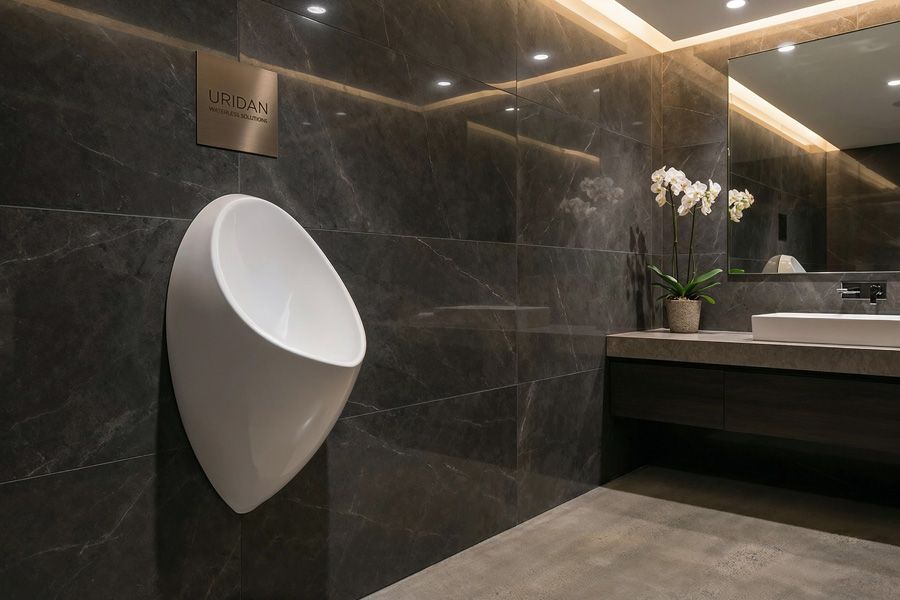
A waterless urinal is a urinal system designed to operate without flush water by using an odour-sealing mechanism at the trap interface. Depending on the technology, this typically involves a trap design and a sealing medium or cartridge that:
- allows urine to drain to waste,
- prevents sewer gas return,
- reduces aerosolisation caused by flushing,
- and stabilises odour performance when maintained correctly.
This is a systems decision, not just a fixture choice—because specifying waterless urinals also means specifying correct maintenance protocols and selecting technology that suits your building’s operational realities.
Why Waterless Urinals Make Sense in NZ Commercial Buildings
1) Potable water use becomes optional
Commercial restrooms can be a persistent, invisible draw on potable water. Waterless urinals remove that requirement entirely for urinal operation. The value is obvious—but the deeper advantage is that you are not just “saving water,” you are reducing dependence on a treated resource for a task that doesn’t require it.
2) Fewer mechanical failure points
Flush valves, sensors, solenoids, cistern systems and controls are all maintenance and risk vectors. Waterless urinals remove the flush mechanism completely, which can reduce the frequency of issues such as:
- running or phantom flushing
- valve and sensor failures
- leaks and water damage events
- vandalism-related flooding risk (in some environments)
Less complexity tends to mean a more stable long-term asset.
3) Cleaner operational behaviour (when specified properly)
Flush urinals can aerosolise contaminants during flushing and leave splashback patterns on surfaces. Waterless systems eliminate the flush event and can reduce that pathway.
But this benefit depends on choosing correct technology and implementing correct cleaning methods. Waterless urinals require the right cleaning chemistry and routine—this is not optional.
4) Better performance in remote or infrastructure-constrained projects
In some builds, it isn’t just about cost savings. It’s about design feasibility. Waterless urinals reduce water supply requirements, which can be meaningful in:
- remote facilities
- visitor centres and public amenities
- temporary buildings and modular builds
- resilience-focused commercial developments
What Architects and Specifiers Should Look For
Not all “waterless” products are equal. The success or failure of waterless urinals in a facility often comes down to the specification detail.
Here’s a practical quality checklist:
Odour control system quality
- Is the odour seal mechanism proven and robust?
- Are consumables (if any) clearly defined and consistently available?
- Is there a clear maintenance cadence that matches traffic levels?
Materials and surface design
- Non-porous, durable surfaces reduce staining and simplify cleaning.
- A geometry that minimises splash and improves washdown behaviour matters.
Servicing model
- Who supports maintenance and training?
- Are spare parts and consumables available locally?
- Is there documentation that facilities teams can actually follow?
Fit-for-purpose guidance
- High-use sites, mixed-use sites, and facilities with variable cleaning standards require different approaches.
- Waterless urinals are a strong solution—but only when matched correctly to site conditions.
Common Misconceptions (That Lead to Poor Outcomes)
“Waterless urinals smell.”
Poorly specified or poorly maintained systems can smell. A properly engineered system with correct cleaning protocols should not.
“They’re maintenance-free.”
No commercial restroom fixture is maintenance-free. Waterless systems replace flush repairs with a simpler, predictable servicing routine. That’s a win—if planned.
“Any cleaner will do.”
This is where failures happen. Waterless systems typically require specific cleaning guidance to protect the seal system and avoid long-term scale or odour issues. If your cleaning contractor isn’t briefed, performance degrades.
The Bigger Point: Restrooms Should Be Designed Like Systems
The best NZ commercial buildings are no longer designed around minimum compliance—they are designed around life-cycle performance.
Waterless urinals represent that philosophy:
- lower resource dependency
- fewer mechanical failure points
- predictable servicing
- long-term operational clarity
The future belongs to buildings that perform well over time—not just on day one.
Next Step: Specify with Confidence
If you’re considering waterless urinals in a commercial project, the key is not simply choosing “waterless.” The key is choosing the right waterless technology and ensuring the building has the right support model behind it: documentation, training, consumable supply, and proven design guidance.
Because in commercial restrooms, outcomes are not driven by intent. They’re driven by specification.
© 2026 WCTNZ® | Waterless Composting Toilets NZ Limited. All Rights Reserved. Unauthorized reproduction, distribution, display, or transmission of any content, design, trademarks, or other materials on this site is strictly prohibited without prior written consent. All intellectual property rights are the exclusive property of WCTNZ® | Waterless Composting Toilets NZ Limited. Continued use of this site indicates your acceptance of our terms and policies, which you affirm to have read and understood. We reserve the right to modify or remove any content at any time without notice. This site and its contents are provided "as is" without warranty of any kind.