















Does urine go into the compost? Does it evaporate, drain away or end up in a bottle? The answer depends on the toilet. Once you understand those differences, it's much easier to choose a system you'll be comfortable using.
Urine brings moisture and nitrogen to the compost, and many purpose-designed systems take urine and solids together. Their chamber size, ventilation and liquid-management features are designed to handle that combined input.
The compost needs to stay moist without becoming waterlogged. Your toilet may evaporate much of the liquid, drain excess liquid to a suitable receiving system, or separate urine before it reaches the solids. Each approach needs proper arrangements for the waste it produces.
Separating urine does not treat it
If urine is diverted before it reaches the compost, it hasn't been treated by that composting process. You'll still need to collect it and take it to a suitable receiving point, or connect it to a treatment or disposal arrangement expressly accepted for that waste.
Evaporation
Ventilation moves air through the toilet, carrying moisture away and helping keep odour out of your bathroom. Some processor systems also use controlled heat to assist evaporation and maintain the conditions they need.
If a model is designed to run without a routine liquid drain, that can give you more installation options. Check that its capacity, operating requirements and the conditions at your property suit the proposed use.
The EcoLet™ 25a and EcoLet™ 65a, for example, provide assisted processing in an on-floor unit. Compare the exact model's capacity and installation requirements with your household and available space.
Evaporation deals with water; the rest of the treatment process still has its job to do. Powered features need a suitable electrical supply too. Use the manufacturer's specifications and our Electrical Safety and Usage Disclaimer. Have an appropriately qualified electrical professional independently assess your power system.
Leachate Drain
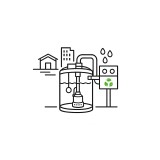
Some toilets drain excess liquid from the chamber. This helps keep space for air when more liquid enters than the system can evaporate.
That liquid is leachate: it has passed through or been in contact with the compost. It's different from urine diverted at the bowl, but it isn't clean water. Passing through the chamber doesn't give you permission to discharge it anywhere on the property.
Have the drain connected to the receiving arrangement specified for your installation. Treatment and land application may be part of that design, depending on the liquid and site. Don't assume an ordinary garden soakaway is suitable.
When considering models such as the Nature Loo™ NL3 or Clivus Multrum™ CM HP, include the liquid-management details in your installation planning from the start.
Urine Diversion to a Designed Receiving System
A urine-diverting toilet separates liquids at the bowl, before they enter the solids chamber. That can be useful when the toilet is designed for it and your expected use, liquid loading or climate makes separation worthwhile.
If you often host gatherings, for example, the toilet may receive much more urine than during normal household use. That's a reason to review the system's capacity and liquid management—not to add a diversion fitting to a model that wasn't designed for one.
The EcoLet™ Separera Mini UD-S has a separate urine outlet. It needs a receiving tank or wastewater system designed for that waste. An ordinary greywater diversion field shouldn't be assumed suitable.
Also ask what happens to the solids. Diverting urine from a system that completes compost treatment is different from separating it to make a small collection container manageable. Both can be useful, but they don't necessarily deliver the same treatment before emptying.
Urine Diversion to Container
A urine bottle keeps the liquid at the toilet until you carry it to a suitable emptying point. This can be convenient in an RV or compact bathroom where you prefer separate, controlled collection.
The Sun-Mar™ GTG™ and EcoLet™ Separera Mini UD-C use this approach. Check how easily you can reach and remove the bottle, how much it holds and how you'll carry it without spilling.
Use a facility that accepts the waste and get the owner's or operator's permission. Our guide to disposing of urine from a container system covers the options.
Which arrangement suits you?
An integrated composting system, a urine-extraction model and a bottle-based RV toilet can all save routine flushing water. What you'll manage day to day differs: some keep urine with the compost, some discharge liquids to a designed receiving system, and others need bottle emptying.
Think about who will use the toilet, where it will sit and where its liquids will go. That makes the choice much more practical than comparing the bowl alone. Read Urine Diversion in Composting Toilets — Yes or No? for a closer comparison.
Not sure which liquid arrangement suits your property?
Call us on 0800 022 027 with your intended use and site details. We can help compare the toilet options and identify what needs to be included in the wastewater design.