
















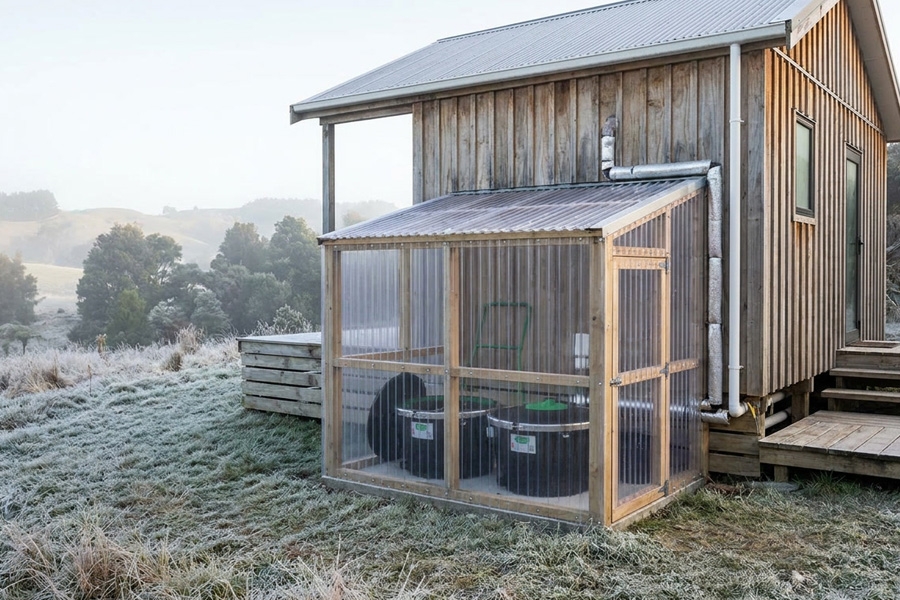
Do composting toilets work in winter in New Zealand? Yes — but cold weather can change how quickly the biological process works and how carefully moisture, ventilation and capacity need to be managed.
Winter does not automatically make a composting toilet unsuitable.
What changes is the operating environment. Lower temperatures, wetter weather, more condensation, buildings being closed up and irregular seasonal use can all influence how the system behaves.
The right response is not to abandon composting. It is to winterise the thinking around the system: choose enough capacity, protect the ventilation pathway and manage moisture with the colder conditions in mind.
The short answer
Cold weather can slow composting, but it does not automatically stop a correctly selected composting toilet from working.
Winter places more importance on treatment capacity, moisture balance, ventilation and realistic peak-use assumptions — particularly for baches, huts and cabins that may sit unused and then receive sudden heavy occupancy.
Composting is a biological process
A composting toilet relies on biological activity, airflow, carbon structure, moisture balance and time.
Temperature influences that biology.
As conditions become colder, decomposition can slow. That is normal biological behaviour and is not, by itself, evidence that the system has failed.
What matters is whether the system has enough treatment volume and operating headroom to accommodate the slower winter process.
Winter does not change the basic composting principles. It changes how much margin the system may need around temperature, moisture, airflow and retention time.
For the permanent technical overview, see Winter Composting Toilets in NZ.
What changes when it gets cold?
| Winter factor | What can change | Practical response |
|---|---|---|
| Temperature | Biological activity can slow. | Allow enough treatment capacity and time rather than sizing the system too tightly. |
| Moisture | Wet weather, condensation or excess liquids can make the composting mass harder to aerate. | Maintain suitable carbon structure and avoid unnecessary liquid loading. |
| Ventilation | Buildings are often closed up more tightly in winter. | Keep the toilet vent route and any required fan operating correctly. |
| Seasonal occupancy | A bach may sit quiet for weeks and then receive a full household or guests over one cold weekend. | Size for realistic peak use, not only the annual average. |
| Servicing | Cold or wet access can make maintenance less convenient. | Plan chamber access and service routines before winter use begins. |
A bach can be harder than a permanently occupied house
A full-time home often develops a consistent operating rhythm.
The users understand the system, the building is regularly occupied and the loading is relatively predictable.
A bach or cabin can behave very differently.
It may sit unused for several weeks and then suddenly receive family, friends or holiday guests during a cold weekend.
That combination — slower biological activity and sudden loading — is one reason seasonal sites should not be sized purely around average occupancy.
Peak use matters. A toilet that looks lightly used across the whole year can still experience demanding short-term loads during weekends and holidays.
See Capacity & Usage Definitions for Composting Toilets for the WCTNZ® approach to full-time, part-time and guest loading.
Cold and wet are not the same problem
Temperature is important, but moisture problems can often cause the more obvious operating symptoms.
A composting mass needs moisture for biological activity, but too much liquid can reduce the air spaces within the material and make aerobic conditions harder to maintain.
Winter buildings can also experience greater condensation and less natural drying.
This makes suitable bulking material and correct liquid management particularly important.
The goal is not to make the compost bone-dry. It is to keep enough structure and moisture balance for air and biology to work together.
Winter is not the time to ignore airflow
Ventilation performs several jobs in a composting toilet.
It supports aerobic conditions, removes moisture and carries toilet odour in the intended direction.
In winter, windows and doors are often closed for longer periods and buildings can operate very differently from summer.
Any specified composting-toilet ventilation pathway therefore needs to remain functional throughout the colder season.
For deeper technical guidance see the Passive Ventilation Design Parameters Guide and Room Ventilation and Extraction Systems Guide.
Winter gives undersized systems less room for error
If decomposition slows, treatment capacity becomes increasingly important.
A larger chamber generally provides more physical storage, more retention time and greater tolerance for changing loading.
A batching system can also provide resting time outside active service while another chamber is used.
This is why WCTNZ® generally prefers realistic capacity headroom rather than designing permanent sanitation around the smallest possible container.
Cold weather does not automatically create a composting-toilet problem. Tight sizing, poor ventilation and poor moisture management can turn cold weather into one.
System type still matters
New Zealand includes warm coastal areas, damp environments, alpine conditions and colder inland sites.
A system performing well in one building form or climate should not automatically be assumed to behave identically somewhere else.
Some projects benefit from large underfloor chambers. Others may suit batching systems or self-contained units with additional mechanical assistance.
WCTNZ® covers the broader climate question in Composting In All Climates.
Winter changes the operating margin — not the basic technology
Composting toilets can operate successfully through New Zealand winters.
The colder season simply places more emphasis on the fundamentals: enough treatment volume, correct ventilation, appropriate moisture balance and realistic use assumptions.
For seasonal buildings, sudden guest loading can be just as important as temperature.
The best winter result usually comes from choosing enough system for the real site — then letting the biological process have the airflow, structure and time it needs.
Winter composting toilet FAQs
Do composting toilets work in winter in New Zealand?
Yes. Cold conditions can slow biological activity, but correctly selected composting toilets can continue operating where capacity, ventilation, moisture and use are appropriately managed.
Does cold weather stop composting completely?
Cold generally slows biological activity rather than creating an automatic system failure. The actual effect depends on the system, installation and thermal environment.
Are composting toilets suitable for South Island properties?
They can be. The system needs to suit the local climate, loading and installation conditions rather than being selected purely from a generic user number.
Why can a bach be challenging in winter?
A bach may sit lightly used and then experience sudden peak loading during a cold weekend. Designing for that peak can be more important than annual average use.
Is ventilation still important in cold weather?
Yes. Ventilation supports aerobic conditions, moisture control and odour management, so any required vent or fan system should remain operational throughout winter.
Planning a composting toilet for a colder site?
WCTNZ® can help compare system capacity, building layout, winter occupancy and ventilation requirements before the toilet is selected.