













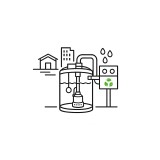


Waterless and flushing urinals perform the same basic user function, but they ask very different things from the building around them.
A flushing urinal needs water supply, flush hardware and ongoing water use. A waterless urinal removes that routine flush and instead relies on gravity drainage, purpose-designed odour control and a defined cleaning and maintenance pathway.
That makes the comparison much broader than purchase price.
For architects, asset owners and facilities teams, the useful comparison is water demand, plumbing, maintenance, consumables, drainage condition and whole-of-life operation.
The short answer
Waterless urinals remove routine flushing-water use and the hardware required solely to deliver that flush.
They still require cleaning, drainage and odour-control maintenance. The business case becomes strongest where the avoided water use and avoided flush-system complexity outweigh the consumables and servicing required by the chosen waterless system.
Waterless vs flushing urinals
| Consideration | Waterless urinal | Flushing urinal |
|---|---|---|
| Routine flush water | None | Required unless another non-potable flushing source is provided |
| Water supply to fixture | Not required for normal waterless operation | Required |
| Flush mechanism | None | Valve, cistern, sensor, solenoid or related mechanism |
| Odour control | Purpose-designed waterless trap, cartridge, membrane or sealing system | Conventional sanitary trap and flushing arrangement |
| Cleaning | Compatible surface cleaning and waterless-system routine | Surface cleaning plus the flushing system |
| Consumables | Can include barrier fluid, cartridges or model-specific care products | Generally fewer odour-barrier consumables, but flush-system parts and water remain operating inputs |
| Drainage | Needs correct gradient, ventilation and maintenance for concentrated urine | Receives urine diluted by flushing water |
| Lifecycle question | Water saved versus care consumables and service | Water and flush maintenance over the life of the fixture |
The difference repeats every time the fixture is used
A single urinal flush may not appear significant.
The commercial difference comes from repetition.
In an office, school, stadium, public facility or hospitality venue, that flushing demand can be repeated hundreds or thousands of times across the operating life of the fixtures.
For a real project, the water calculation should use the actual building assumptions.
Annual flush water = flush volume × number of uses × operating days.
A waterless urinal removes that normal flush-water term from the calculation.
This is why the strongest business cases are generally found in buildings with meaningful urinal traffic rather than in very lightly used installations.
Removing water also removes the system that delivers it
A flushing urinal needs more than water.
The water must be delivered and controlled.
Depending on the fixture, that can involve a branch supply, isolating valve, cistern, flush valve, sensor, solenoid, control components or combinations of these.
These components can perform reliably for many years, but they remain part of the asset and therefore part of the maintenance pathway.
Waterless urinals remove that flush-specific layer.
Important: simpler flush plumbing does not mean the entire urinal is maintenance-free. The waterless odour barrier and drainage arrangement become the systems that need to be understood and maintained correctly.
Both systems need maintenance — just in different places
A common mistake is presenting waterless urinals as though there is nothing left to maintain.
That is not the WCTNZ® position.
A waterless fixture needs proper cleaning, a functioning odour barrier and drainage that remains in good condition.
Depending on the technology, barrier fluid may require top-up, a cartridge may require replacement or a trap may need scheduled deep cleaning.
A flushing urinal has its own maintenance architecture: flush components, sensors, valves, cisterns, water supply and the sanitary drain.
The lifecycle comparison is one maintenance system versus another — not maintenance versus no maintenance.
Waterless design puts more importance on the waste line
Flush water dilutes urine and adds hydraulic movement to the drainage system.
A waterless urinal sends a more concentrated urine stream into the waste line.
That means gradient, pipe condition, access, ventilation and maintenance should be considered deliberately.
A new-build project can resolve these details from the beginning.
In a retrofit, the existing branch should be assessed rather than assumed to be ideal simply because a conventional urinal was previously connected to it.
For uridan see uridan Installation Overview.
The flush is not the same thing as hygiene
A flushing urinal still requires physical cleaning.
Likewise, removing the flush does not remove cleaning from the waterless fixture.
The important difference is that a waterless system should be cleaned using products and practices compatible with its trap and odour-control technology.
For uridan, WCTNZ® uses a defined maintenance system built around uriCLEAN®, uriLOCK®, uriSTRONG® and uriTABS® as appropriate.
See uridan Maintenance Instructions.
What should actually be included?
The purchase price of the fixture is only the starting point.
A useful whole-of-life comparison can include:
- Fixture purchase and installation.
- Water-supply plumbing required by the flushing alternative.
- Water and wastewater charges where applicable.
- Flush-valve, sensor or cistern maintenance.
- Waterless-system consumables.
- Cleaning time and cleaning products.
- Scheduled trap or drainage service.
- Replacement parts.
- Expected operating life.
The answer will vary from building to building.
That is why WCTNZ® prefers a project-based comparison rather than claiming one universal payback period.
High-use commercial buildings
Where urinal use is frequent, the waterless advantage is repeated frequently too.
Schools, offices, clubs, public amenities, transport facilities, hospitality venues and recreation buildings can therefore be logical places to consider the technology.
The project still needs the correct fixture, drainage and operational ownership.
But the baseline question becomes increasingly difficult to ignore:
If the user function can be achieved without flushing water, what value is the ongoing flush adding to the building?
How uridan approaches the trade-off
uridan is designed specifically around waterless operation.
Its siphon and uriLOCK® system provide the odour barrier, while the smooth fixture surfaces and dedicated care products support the operational pathway.
For New Zealand projects, WCTNZ® provides local product selection, supply, technical guidance and ongoing consumables support.
Explore uridan in New Zealand »
Waterless vs flush urinal FAQs
Do waterless urinals save water?
Yes. They remove routine urinal flushing water. The actual amount saved depends on the flushing fixture being replaced, use frequency and operating days.
Are waterless urinals cheaper to maintain?
Not automatically in every building. They remove flush-system maintenance and routine flush-water use but introduce their own trap, consumable and care requirements. Whole-life cost should be assessed for the actual site.
Do waterless urinals need consumables?
Many do. The requirement depends on the technology. uridan uses uriLOCK® blocking fluid and a defined cleaning and deep-maintenance system.
Can waterless urinals replace existing flushing urinals?
Often yes, but the existing drainage, outlet position, gradient, ventilation and redundant water connection should be assessed first.
Which is better for a high-use commercial washroom?
Waterless technology becomes particularly attractive where repeated flushing-water demand is high, provided the building has suitable drainage and a clear maintenance regime.
Comparing urinals for a commercial project?
WCTNZ® can help compare waterless and conventional urinal pathways against expected use, project layout, drainage, ongoing maintenance and whole-of-life operation.