
















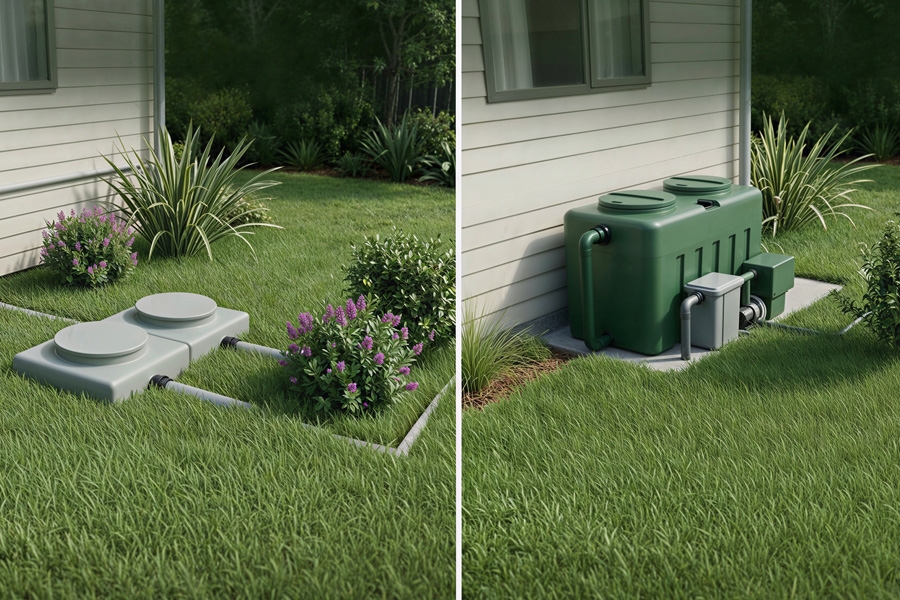
Why do some greywater projects stay relatively simple while others need a more developed system? Usually because the source, loading, site or intended outcome has changed.
Greywater projects do not become more demanding because somebody has decided to overcomplicate them.
They become more demanding when the real project asks more of the wastewater system.
A heavier wastewater source, greater use, restricted land area, pumping requirements or a more controlled reuse objective can all move a project away from the simplest pathway.
The difference is usually not attitude. It is project fit.
The short answer
Four things usually explain why one greywater project can stay relatively simple while another cannot: wastewater source, level of use, site conditions and the intended outcome.
When all four are relatively forgiving, a simpler direction may be realistic. As one or more become more demanding, the project may need greater filtration, pumping, treatment, control or a more developed discharge arrangement.
Greywater sounds simpler than blackwater — but that is only the starting point
Greywater is different from toilet wastewater.
That difference can allow very useful source-separated wastewater strategies and, in suitable projects, a simpler pathway than conventional mixed wastewater.
But the word greywater covers a wide range of actual water quality and project conditions.
A small amount of shower water from an occasional-use cabin and a full household stream including kitchen and laundry water are both described as greywater. They are not automatically the same design problem.
The question is not whether greywater is generally easier than blackwater. The useful question is how demanding this particular greywater stream is on this particular site.
What tends to keep a project simple — and what pushes it further?
| Project factor | Tends toward a simpler response | Can push toward a more developed response |
|---|---|---|
| Wastewater source | Lighter bathroom-dominant flows | Kitchen inclusion, grease, food solids and heavier organic loading |
| Use level | Low or occasional occupancy | Full-time household, shared-use or higher sustained loading |
| Site | Good fall, useful land area and straightforward layout | Restricted area, awkward levels, pumping or tighter site constraints |
| Desired outcome | A suitable straightforward discharge pathway | More controlled irrigation, reuse or water-quality objective |
| System operation | Simple gravity-led movement and manageable maintenance | Additional filtration, pumping, storage control or treatment stages |
Why some greywater projects genuinely stay straightforward
Some projects have all the ingredients for a relatively simple response.
The wastewater may be light. Occupancy may be low. The site may have adequate space and useful fall. The project may only need a sensible pathway for moving suitable greywater to the next stage.
Those conditions can make a small home, bach, cabin or tiny-home project comparatively manageable.
That does not mean the design should be casual.
It means the project is placing fewer demands on the wastewater response.
For the broader starting point, see About Greywater.
Complexity usually appears for a reason
Other projects move beyond the simplest assumptions because one or more important conditions have changed.
Sometimes the incoming wastewater becomes more demanding.
Sometimes there is simply more of it.
Sometimes a difficult site makes gravity discharge unrealistic.
And sometimes the desired end result requires better control over the water before it reaches the land or irrigation system.
More developed does not mean failed. It usually means the actual project has become clear enough to show that a stronger wastewater response is appropriate.
Bathroom-only greywater is not the same as kitchen-inclusive greywater
The source of the wastewater is one of the strongest early indicators of how demanding the system may become.
Showers, baths and hand basins generally create a different starting point from a combined stream that also carries kitchen wastewater.
Kitchen wastewater is still greywater, but it can contain grease, oils, suspended food solids and higher organic loading.
That can increase filtration needs, grease-management considerations and downstream maintenance requirements.
It does not automatically force every kitchen-inclusive project into one fixed solution.
It simply reduces the usefulness of assuming all greywater behaves the same way.
More use means less room for weak assumptions
A lightly used cabin is different from a permanent family home.
A permanent family home is different from accommodation, shared-use or commercial wastewater.
As occupancy and frequency increase, the system has to manage more water over time.
That can affect pipework, filtering, pumping, discharge area, irrigation distribution and servicing frequency.
Project scale therefore matters even when the wastewater remains within the same broad greywater category.
A simple wastewater stream can still sit on a difficult site
Site conditions can completely change what becomes practical.
Useful gravity fall can simplify a system.
Poor levels may introduce pumping.
A generous land area offers different options from a tightly constrained property.
Access, layout and the position of buildings can all affect where water can realistically move.
Greywater should be matched to both sides of the equation: the wastewater being produced and the site expected to receive it.
See Greywater System Pathways for the wider WCTNZ® pathway structure.
The more you ask the water to do, the more control may be needed
The intended result also changes the system conversation.
A project seeking a straightforward suitable discharge arrangement has a different objective from one seeking more controlled irrigation or reuse.
The more refined the desired outcome becomes, the more carefully water quality, distribution and system operation may need to be controlled.
This is why treatment should not be thought of simply as “complicated diversion”.
It is a different pathway for projects asking more from the water before its next use or discharge.
Our dedicated article Greywater Diversion vs Treatment: What Changes the Decision? goes deeper into that distinction.
Why tiny homes can sit on either side of the line
Tiny homes demonstrate the issue particularly well.
A lightly used one-person tiny home with a suitable site may have a relatively straightforward greywater profile.
An identical-sized home occupied full-time by two people, including kitchen and laundry wastewater on a constrained site, may need a more considered system.
The floor area did not change.
The wastewater project did.
See Greywater for Tiny Homes in New Zealand: What Usually Matters Most.
Simple is an outcome of good project fit — not something to force
There is value in keeping greywater systems as straightforward as the project reasonably allows.
But simplicity should be the result of suitable conditions, not a target imposed before the wastewater and site are understood.
Some sites genuinely need little intervention.
Others need more filtration, pumping, treatment or distribution control because the real project demands it.
The strongest greywater pathway is usually the simplest response that genuinely matches the wastewater source, loading, site conditions and intended outcome.
Greywater project complexity FAQs
Why are some greywater systems much simpler than others?
Projects with lighter wastewater, lower loading, useful gravity fall, adequate land area and straightforward discharge objectives can often support a simpler response.
What usually makes a greywater project more complicated?
Kitchen wastewater, higher occupancy, greater flow, site constraints, pumping requirements and more controlled irrigation or reuse objectives can all increase system demands.
Does kitchen wastewater automatically mean I need a treatment system?
No. Kitchen inclusion does not automatically dictate one solution, but it can make the wastewater more demanding because of grease, food solids and higher organic loading.
Does a small home always need a simple greywater system?
No. Building size is only one factor. Full-time occupancy, wastewater sources and site conditions can make a small dwelling a relatively demanding wastewater project.
When should I compare greywater diversion with treatment?
Once the wastewater sources, use level, site constraints and intended outcome are reasonably understood. Those factors make the diversion-versus-treatment discussion much more meaningful.
Not sure how simple your greywater project really is?
WCTNZ® can help you identify the wastewater sources, loading, site constraints and likely pathway before a system is selected.