
















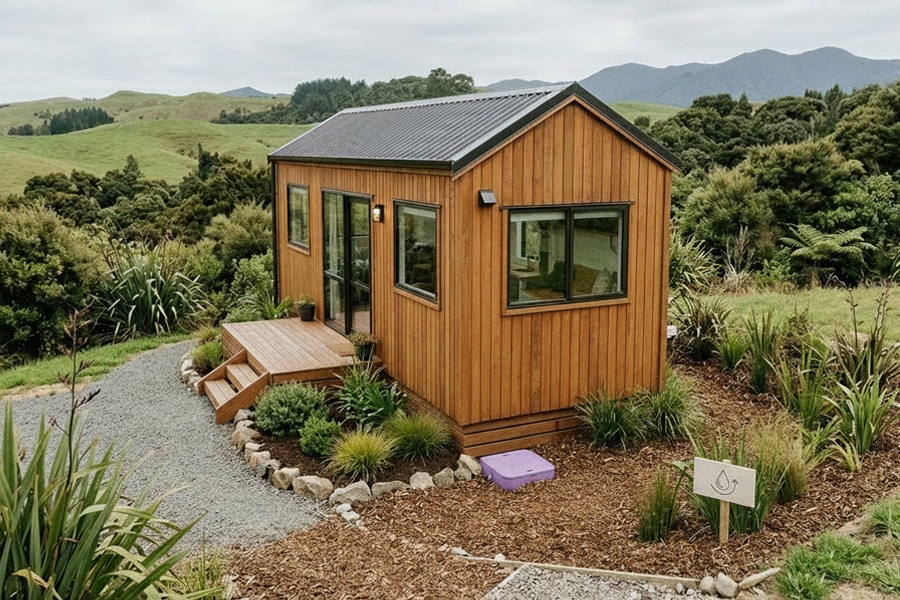
Greywater for a tiny home in New Zealand can be simpler than for a larger house — but the small size of the dwelling does not automatically make the wastewater problem simple.
The real answer still depends on where the water comes from, how many people use the home, whether use is full-time or occasional, what the site can accommodate and what the project expects to happen to the greywater next.
A tiny home can sit at the simpler end of the greywater spectrum. It can also become surprisingly demanding when kitchen wastewater, permanent occupancy, restricted land area, difficult fall or other site constraints are added to the project.
The best approach is therefore to assess the real wastewater and the real site — not the word “tiny”.
The short answer
Tiny home greywater is often manageable, but dwelling size alone does not determine the system.
A lightly used tiny home with relatively light wastewater and a forgiving site may support a simpler pathway. Full-time occupancy, kitchen wastewater, greater flow, pumping requirements or tighter discharge conditions can push the same-sized dwelling toward a more developed greywater response.
Why people expect tiny home greywater to be easy
The assumption usually starts with floor area.
A tiny home is physically smaller than a conventional house, so it is natural to assume everything connected with its wastewater should be smaller and easier as well.
Sometimes that is true.
A one-person dwelling used lightly can generate much less greywater than a full-size family home. A simple bathroom-only wastewater stream may also be easier to manage than a mixed household flow.
The mistake is treating the size of the building as though it tells us everything about the wastewater.
Greywater is driven by the water being produced and the site receiving it — not simply by the number of square metres inside the house.
Five factors shape the likely tiny-home greywater pathway
| Factor | What to ask | Why it matters |
|---|---|---|
| Wastewater source | Is the system receiving bathroom water only, or kitchen and laundry water as well? | Different sources create different solids, grease and organic loading. |
| Occupancy | One person, two people, visitors or changing household numbers? | More users generally mean more wastewater and less operating margin. |
| Use pattern | Occasional bach-style use or permanent full-time living? | Daily continuous loading is different from intermittent use. |
| Site | Is there suitable fall, discharge area, access and space? | The site can make a seemingly simple project much more demanding. |
| Intended outcome | Simple suitable discharge, controlled irrigation or a more developed reuse objective? | The more controlled the desired result, the more developed the system may need to become. |
What makes tiny home greywater genuinely easier in some projects
Some tiny home projects really do align well with a simpler greywater response.
That normally happens when several helpful conditions occur together.
- Occupancy is low and reasonably predictable.
- The amount of wastewater generated is modest.
- The incoming greywater is relatively light.
- The site provides adequate space and a workable discharge pathway.
- The project does not require a highly controlled treatment or reuse outcome.
When those factors line up, the smaller scale of the dwelling can genuinely work in the project's favour.
For the wider foundation, see About Greywater.
A small building can still create a substantial wastewater question
A tiny home becomes more demanding when one or more of the easy assumptions disappear.
The house might be small but occupied every day.
It may have a normal kitchen, washing machine, shower and other fixtures operating with the same frequency as those in a larger dwelling.
The site may also have limited fall, restricted land area, poor access or a need for pumping.
None of those issues are created by the tiny home concept itself. They simply demonstrate that wastewater loading and building footprint are not the same measurement.
Tiny does not automatically mean low-use. A permanent tiny home can generate wastewater every day of the year even though the building footprint remains small.
Why the kitchen can change the discussion
The source of the wastewater is one of the first things WCTNZ® looks at.
Bathroom greywater from showers, baths and hand basins generally presents a different wastewater profile from water that also includes the kitchen.
Kitchen wastewater is still greywater, but it commonly contains greater amounts of grease, oil, food solids and organic material.
That additional loading can make the downstream pathway less forgiving.
It does not mean every tiny home with a kitchen automatically needs the same system. It means kitchen inclusion should be understood rather than treated as though all greywater sources are identical.
Full-time living changes the loading
A tiny home used for occasional weekends is not the same wastewater project as a tiny home occupied permanently.
Likewise, a dwelling for one person is not automatically comparable with a home occupied by two people every day plus visitors.
Greywater planning needs to reflect realistic behaviour.
That means showers, laundry frequency, cooking, cleaning and other daily water use — not simply the theoretical capacity of the building.
A small house with permanent occupants should be designed around permanent wastewater use, not around an idealised idea of tiny-home living.
Site constraints can matter more than house size
A small wastewater flow does not guarantee a simple site.
Available fall, pumping needs, discharge area, ground conditions, access and building placement can all change what becomes practical.
A tiny home on a forgiving rural site may have very different options from an identical tiny home positioned on a constrained section.
This is why WCTNZ® considers the dwelling, the wastewater and the site together.
For the broader decision structure, see Greywater System Pathways.
What do you actually want the greywater system to achieve?
The intended outcome matters too.
A project seeking a suitable and relatively straightforward discharge pathway is asking a different question from a project seeking more controlled irrigation or a higher level of treatment and reuse.
As the required outcome becomes more controlled, the system response may also need to become more developed.
That is why the greywater decision should not begin with a product.
It should begin with what water is entering the system and what the project needs to happen to it afterward.
What tiny home owners should establish first
- Which wastewater sources will enter the greywater system?
- Is kitchen wastewater included?
- How many people will normally occupy the home?
- Is occupancy full-time, part-time or occasional?
- What site limitations are already known?
- Is gravity available or is pumping likely?
- What discharge, irrigation or reuse outcome is wanted?
Once those questions are answered, the project becomes much easier to place within a realistic greywater pathway.
For a wider explanation of why some projects stay simpler than others, see Why Some Greywater Projects Stay Simple While Others Do Not.
Tiny home greywater can be simple — when the project conditions support it
Tiny homes can absolutely sit at the simpler end of the greywater spectrum.
But the advantage comes from lower loading, suitable wastewater sources and workable site conditions — not from the building label alone.
A small dwelling with full-time use, kitchen wastewater and a constrained site can require more thought than expected.
The strongest tiny-home greywater pathway is the one matched to the real wastewater source, real occupancy, real site and real intended outcome.
Tiny home greywater FAQs
Is greywater easier to manage in a tiny home?
It can be, particularly where occupancy and wastewater loading are low and the site is suitable. However, the small building footprint does not automatically determine the greywater system.
Does kitchen wastewater count as greywater?
Yes. Kitchen wastewater remains greywater, but it is often one of the more demanding household greywater sources because of grease, oils, food solids and higher organic loading.
Does a full-time tiny home need a different greywater approach from a weekend cabin?
Potentially. Full-time occupancy produces steady wastewater loading, while occasional use may create a very different flow profile. The system should reflect realistic use.
Can tiny-home greywater be used for irrigation?
Greywater can support irrigation pathways where the wastewater source, system, site and intended application are suitable. The correct arrangement is project-specific.
What should I work out before choosing a tiny-home greywater system?
Start with the wastewater sources, kitchen inclusion, occupancy, use pattern, available fall, site constraints and the intended discharge or reuse outcome.
Planning greywater for a tiny home?
WCTNZ® can help you work through wastewater sources, occupancy, kitchen inclusion, site conditions and the likely system pathway before you commit to equipment.